Driving Motors
Introduction
Beacuse moving in the physical world takes a lot of power, we need to use higher-voltage sources to drive our motors than the low-voltage logic of our Arduino. For this activity, we will be learning about the L298n Motor Driver which you will be using in your robots for the rest of term.
Note that we'll just use our Arduinos to power the motor driver for now, not a battery.
Materials
Activity
Build the Circuit
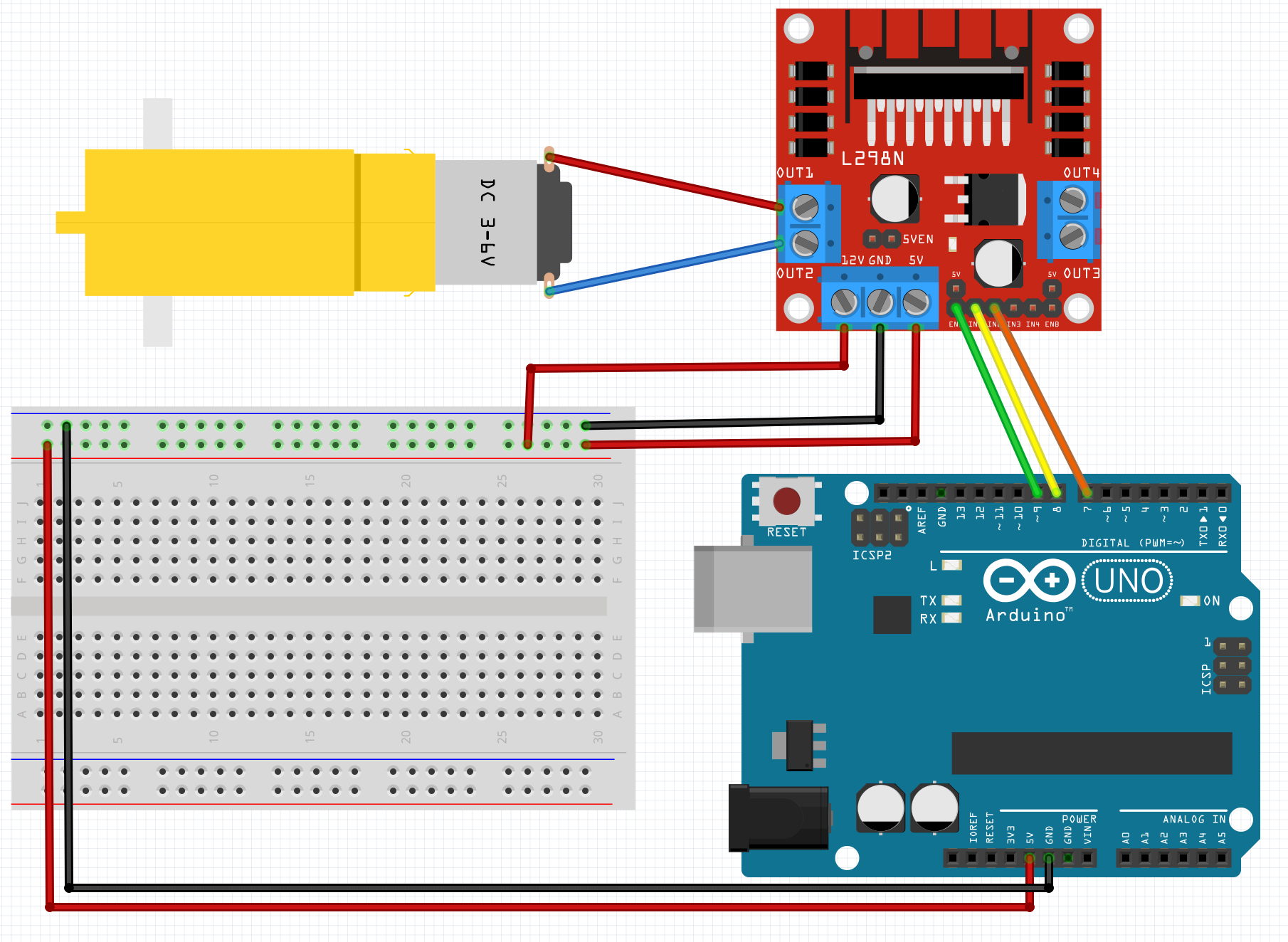
Build one side of the L298N circuit. Getting familiar with the meaning of the pinouts will be helpful for when you encounter this in lab. Use the following pins for your Arduino:
#define enA 9   // Enable pin for Motor A — must be a PWM-capable pin
#define in1 8   // Direction control pin 1 for Motor A
#define in2 7   // Direction control pin 2 for Motor A
You only need one motor to understand the driver, so just build one side. Make sure your wiring aligns with the pinout.
Test the circuit
Using the following code, test your motor.
#define enA 9   // Enable pin for Motor A — must be a PWM-capable pin
#define in1 8   // Direction control pin 1 for Motor A
#define in2 7   // Direction control pin 2 for Motor A

void setup() {
    // Set motor control pins as outputs
    pinMode(enA, OUTPUT);
    pinMode(in1, OUTPUT);
    pinMode(in2, OUTPUT);
}

void loop() {
    digitalWrite(in1, LOW);
    digitalWrite(in2, HIGH);
    digitalWrite(enA, HIGH); // Turn on motor at full power (no PWM)
    // analogWrite(enA, 127); // Turn on motor at half power (PWM)
}
Speed Control
Using analogWrite(enA, pwm) where pwm can range from 0-255, run your motor at different speeds.
Next, use a potentiometer to control the motor speed. You may want to use the Arduino map function to translate the sensor reading (which is in the range 0-1024) to the motor control range 0-255.
On your own
You'll get plenty of practice with these drivers in lab, but it's worth also practicing with these materials on your own time. Spend some time with a multimeter and a driver measuring the output of different components.
Philosophical Connection
PWM has some similarity to the way our motor neurons control our muscles. Each spike of a neuron makes our muscles twitch an imperceptible amount. Many, many twitches add up into a muscle movement.
Some people use the ability of our muscles to be stimulated by electrical activity to develop novel computer interfaces. We could call this system a cybernetic enhancement. One characterization of this kind of work is that it is techno-futurism, that is, works within a value system that promotes technological solutions to human problems. Do you find this kind of work exciting or scary? Both? Discuss.